Table of Contents
The flat roof replacement cost UK homeowners pay in 2026 usually lands between £2,800 and £7,500, at about £75 per square metre. That is the range MyBuilder and Checkatrade both publish, and it covers most domestic jobs, from a small garage to a 30 square metre extension.
The spread is wide for a reason. A felt roof on a single garage and a GRP roof on a 50 square metre extension are barely the same job, and the quote you sign depends on the covering, the deck underneath, the insulation rules and how the roofer gets up there.
This guide gives you the 2026 prices by material and by size, then the extras that move the total, so you can read a quote instead of guessing at it.
You will find the rest of our Roof Repairing guides in the category as this section grows, starting with the repair prices that come before a full replacement.
How much a new flat roof costs in 2026
For most homes the bill sits in that £2,800 to £7,500 band. A small porch or garage roof of about 20 square metres usually comes in at the bottom of it, while a large extension pushes toward the top.
The Federation of Master Builders puts the average replacement at £8,000, which sounds higher until you see what it counts: a full build-up with a new deck, insulation, membrane and trims, rather than the covering alone.
Size is the biggest single driver, and the FMB table shows it plainly. Their figures are full build-up prices, so they run higher than a covering-only rate, and they are the honest comparison when two quotes use different bases.
| Roof | Typical total |
|---|---|
| 20 m², small porch or garage | £2,800 to £3,600 |
| 30 m², small extension | £4,200 to £5,400 |
| 50 m², medium extension | £7,000 to £9,000 |
| 70 m², larger extension | £9,800 to £12,600 |
The per-metre average hides one quirk: small roofs cost more per square metre than large ones. A 10 square metre roof still needs the same van, the same setup and the same disposal run as a 30 square metre one, so the fixed costs spread over fewer metres.
That is why a garage roof can look expensive per metre and still be the cheapest job on the list, and why most roofers apply a minimum job charge of £300 to £500.
Most single garages have a flat roof, and a garage roof is the cheapest end of the range. MyBuilder puts a single flat garage roof at £700 to £1,000 and a double at £900 to £1,400, though a garage with a rotten deck costs more.
An older garage roof is worth an asbestos check before anyone starts work. If the garage is getting a proper sort-out at the same time, our appliance garage ideas cover the storage side.
Flat Roof Replacement Cost UK by Material: Felt, EPDM and GRP
One honest note before the numbers: the flat roof replacement cost UK figures below are supply-and-fit rates for the covering only, including labour and standard edge trims. They do not include scaffolding, insulation upgrades or deck repairs, and that is why two quotes for the same roof can sit £1,000 apart.
| Material | Cost per m² | 20 m² extension | Lifespan |
|---|---|---|---|
| Felt (torch-on) | £40 to £70 | £800 to £1,400 | 15 to 20 years |
| EPDM rubber | £50 to £90 | £1,000 to £1,800 | 30 to 50 years |
| GRP fibreglass | £80 to £130 | £1,600 to £2,600 | 25 to 40 years |
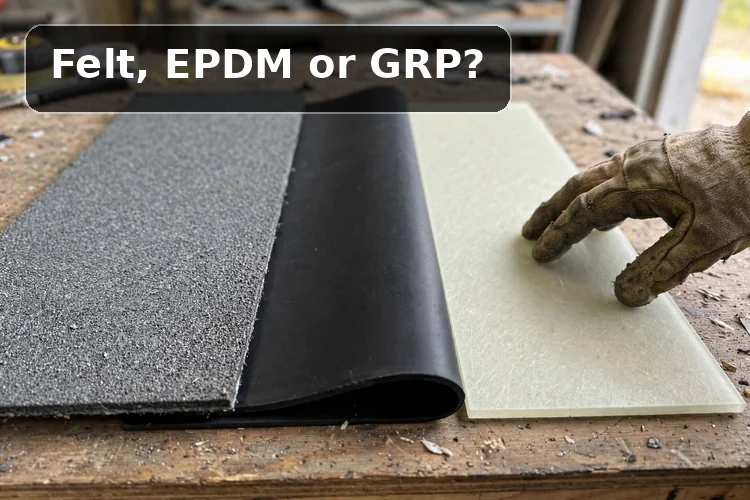
The cheapest covering is rarely the cheapest roof. Felt costs the least to lay and the most to own, because it lasts 15 to 20 years and you will likely replace it twice in the time an EPDM roof lasts once.
EPDM sits in the middle on price and wins on whole-life cost for most homes. GRP costs the most upfront and earns it on balconies and walk-on roofs, where a hard walk-on finish matters more than saving a few hundred pounds.
The same material can be priced two ways, and this is where quotes get confusing. A covering-only rate and a warm-roof rate are different jobs.
MyBuilder’s per-metre figures for a warm roof run £70 to £100 for felt, £90 to £130 for EPDM and £95 to £150 for GRP, because the insulation is in the price. Always check which basis your quote uses before you compare two numbers.
What a quote actually includes, and what it leaves out
A proper quote strips the old covering, repairs or replaces the deck where it has rotted, lays the new membrane, and fits the edge trims and flashings. Labour is around 40% of the total on most jobs, and materials make up the rest.
If a quote does not mention the deck at all, it is not a complete quote, because the deck is the part nobody can price until the old covering comes off.
The lines that get left out are the ones that hurt later. Waste disposal, scaffold, insulation and VAT can each add hundreds, and a quote that omits them looks cheap until the extras arrive as separate bills.
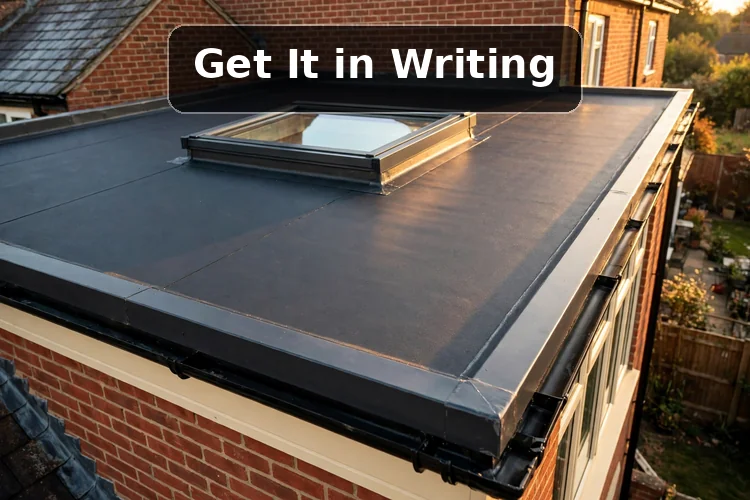
Ask for one fixed price that lists the covering, the deck work, the access, the disposal and the VAT, and get it in writing before anyone climbs a ladder.
Before you accept any quote, check the roofer the same way you check the price. Ask to see public liability insurance, check membership of a recognised trade body such as the NFRC or the FMB, and verify the business through Companies House or the TrustMark directory.
A roofer who will not show insurance is not a roofer to let on your roof.
A flat roof is not a DIY job, even for a confident homeowner. The membrane goes on in one piece or in layers that have to cure, and a bad seam leaks for years before it shows inside.
Save the DIY energy for the rooms below; our DIY home improvement guide covers the jobs that are safe to take on yourself.

Felt, EPDM or GRP: which one is worth the money?
Felt is the old workhorse: layers of bitumen sheet, usually torch-on, fused to the deck with heat. It is cheap, it goes on fast, and it suits a garage or a roof you plan to replace again in fifteen years. Its weakness is the seams, and every seam is a future leak.
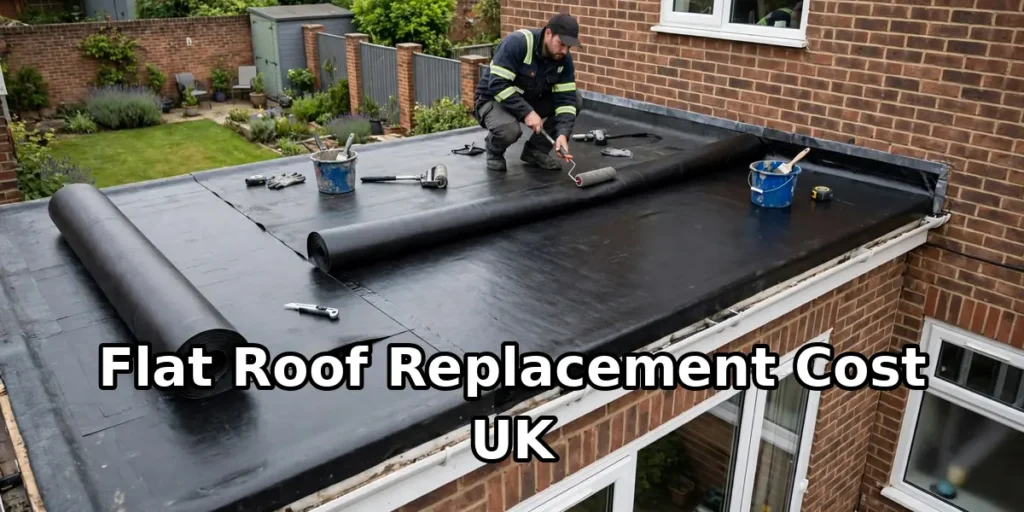
EPDM is a single sheet of rubber, glued down and joined with tape at the seams. There are almost no joints to fail, it shrugs off sun and frost, and it lasts 30 to 50 years.
For most residential roofs it is the best whole-life value, and it goes on in a day or two because there is nothing to cure.
GRP is resin brushed over fibreglass matting until it cures hard into one solid shell. It is the dearest of the three and the slowest to lay, around two to three days for the same area, because each layer has to cure. It earns its price where people walk: balconies, roof terraces and anywhere the roof is also a floor.
A fourth option, single-ply PVC or TPO, sits between EPDM and GRP on price at around £100 to £150 per square metre for a warm-roof build, and suits larger modern roofs. It is less common on small domestic jobs, which is why most guides lead with the big three.
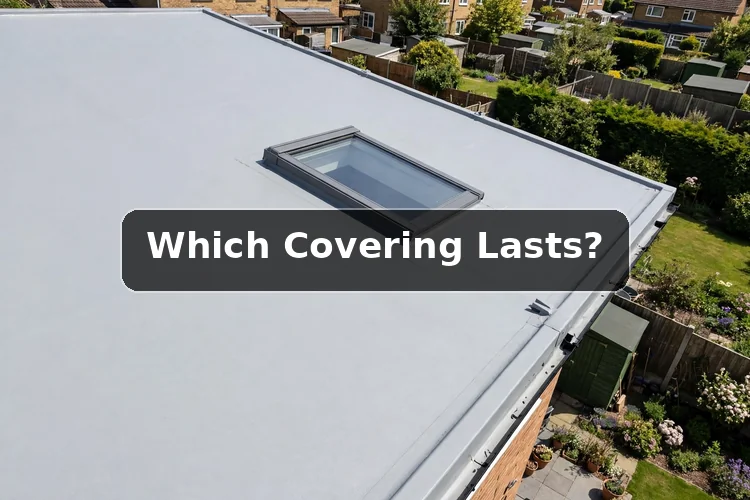
If the choice still feels close, ask what the roof is for. A garage that nobody walks on wants felt or EPDM. A kitchen extension with a rooflight wants EPDM. A balcony wants GRP, and nothing else will do the job properly.
The extras that move the price
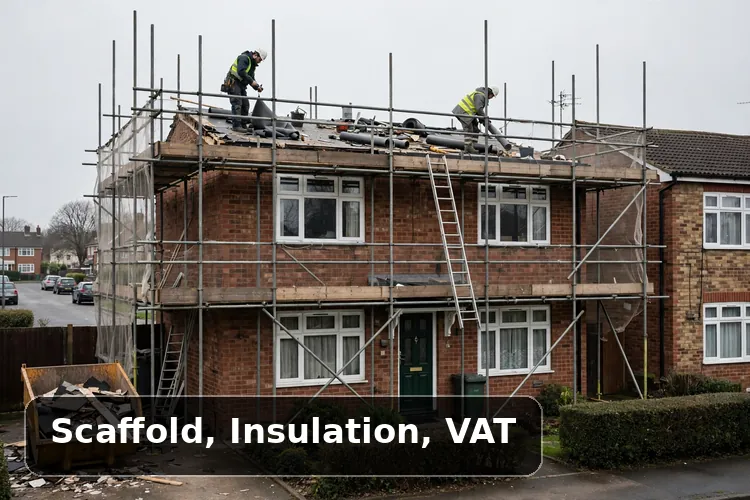
Scaffold is the extra that surprises most people, and it is the line that most often pushes a flat roof replacement cost UK total past the headline range. MyBuilder puts scaffold on a standard two-storey house at about £850 to £1,200, and Checkatrade gives £700 to £1,300.
A single-storey extension often needs far less, sometimes just a tower, and that is worth asking about.
Insulation is the second extra, and it is not optional when the rules bite. If you replace more than half the covering over a heated room, Building Regulations treat the roof as a renovated thermal element and require the insulation to be brought up to current standards, a U-value of 0.18 W/m²K or better.
The upgrade typically adds £35 to £55 per square metre, and a roofer on a Competent Person Scheme can self-certify the work instead of going through the council. You can check whether your job needs approval on the GOV.UK building regulations approval pages.
Then there is the waste and the tax. Stripping an old roof fills a skip, and disposal usually runs £100 to £1,000 depending on size and access.
VAT is 20% on a standard replacement, and the reduced 5% rate only applies in specific circumstances, such as a property left empty for two years or more. And if you live in London, expect 10 to 20% above the national rates, with central London running 20 to 30% higher.
None of these extras is a reason to pick the cheapest quote. They are the reason to pick the clearest one, because a quote that hides them is not cheaper, it is incomplete.
Repair or replace: the call that saves thousands
A flat roof does not need replacing just because it leaks. Most repairs run £150 to £500, and a patch or a re-cover can add years to a roof whose deck is still sound.
Our guide to roof repair cost UK covers the smaller fixes, the leak tracing and the flashing work, and it is the right first read if the damage is local.
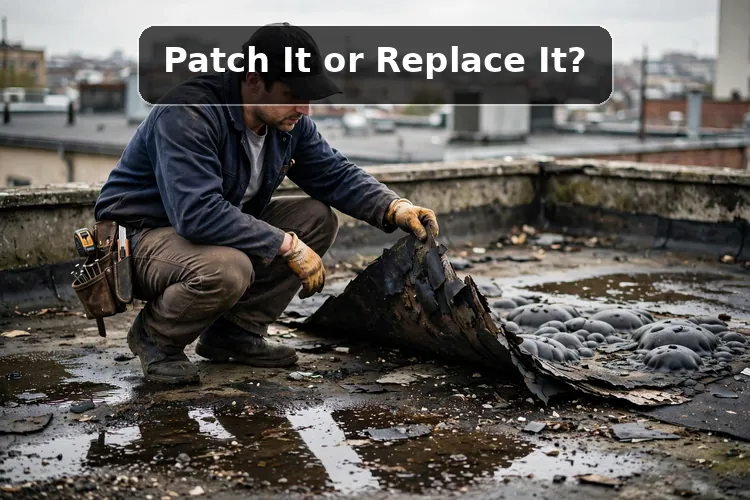
Replacement is the right call when the covering is tired all over, the deck has rotted, or the roof has been patched so often that nobody can say what is underneath any more.
Ponding water that stays for days, blisters across the whole surface and damp inside the house all point the same way.
Damp stains on the ceiling or the walls are the usual first sign, and once the roof is fixed, our guide to wall damage repair before painting covers the inside.
There is a middle option worth asking about. If the roof has a single layer, the deck is dry and solid, and there is no damp inside, a new covering laid over the old one can save 20 to 30%.
It is not right for a roof with two layers already, or one with a wet deck, and a good roofer will say so rather than sell it.
The test is simple: if the deck is sound and the damage is local, repair it. If the covering is failing everywhere or the deck is wet, replace it. Guessing wrong costs more either way, because a patch on a dead roof fails within a year and a replacement on a sound roof wastes thousands.
Flat roof replacement questions, answered
These are the questions I hear most, with the short answers I give friends before they spend anything.
How much does a flat roof replacement cost per square metre?
Between £60 and £130 per square metre in 2026 for most domestic jobs, including materials and labour. Felt sits at the bottom of that range and GRP at the top, and a small roof costs more per square metre than a large one, because the fixed costs of getting on site stay the same whatever the size.
Do I need building regulations approval to replace a flat roof?
Usually yes, if you replace more than half the covering over a heated room, because that counts as renovating a thermal element and the insulation must be upgraded.
Approval can come from your roofer if they are on a Competent Person Scheme, or through your council’s building control. Most re-roofs need no planning permission, unless the house is listed or in a conservation area.
Can a new flat roof go over the old one?
Yes, if there is only one layer, the deck is dry and solid, and there is no damp inside. An overlay like that can save 20 to 30% against a full strip-out.
It is the wrong choice for a roof with two layers already, or a wet deck, and any roofer who offers it without checking the deck first is cutting corners.
How long does a flat roof replacement take?
Most domestic flat roofs take one to three days on site. EPDM is quickest at about one to two days, because it goes down as a single membrane with nothing to cure.
GRP takes two to three days, because each layer has to cure before the next goes on. Scaffolding usually stays up for a week or two in total, and bad weather can add days.
Which flat roof material lasts the longest?
EPDM rubber, at 30 to 50 years, which is why it is the default choice for most homes. GRP lasts 25 to 40 years and felt 15 to 20.
A roof that is looked after, cleared of leaves and checked after storms, will beat the bottom of its range, and one that is ignored will not reach the top of it.
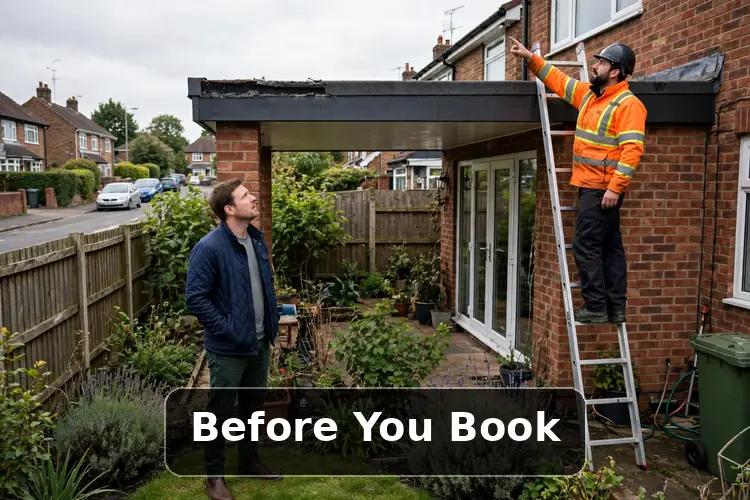
The one quote to get before you sign anything
If you remember one number from all of this, make it £75 per square metre, because that is where the flat roof replacement cost UK average sits in 2026.
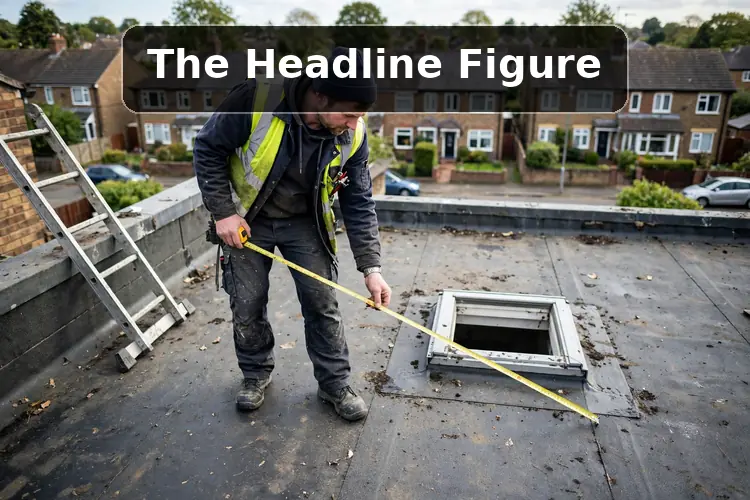
Then remember that the number is only a starting point, and the quote that matters is the one written for your roof, after a survey, with the deck, the access, the insulation and the VAT all on the same page.
Get three written quotes, compare them line by line, and check that each one names the covering, the insulation, the deck work and the guarantee.
Ask for a deposit of 10 to 25%, never the full amount upfront, and check the roofer is insured and a member of a recognised trade body.
The Federation of Master Builders guide to flat roof replacement cost is a useful second opinion on the numbers, and a roofer who will not put their price in writing is a roofer to walk away from.
A flat roof is the least glamorous job on a house, and the one that matters most when it rains. Spend the money once, spend it on the right covering, and you will not think about it again for thirty years.